In celebration of Nurses Week, we share insights from nursing leaders on their top priorities: increasing hands-on practice for new nurses, achieving consistent training outcomes, easing the burden on preceptors and resources, and the role VR can play in addressing these critical needs.
As we celebrate Nurses Week, we're reflecting on what we've heard from the people who lead, teach, and support the profession. Our team talks to nursing leaders just about everywhere—in hospitals, on conference floors, over Zoom, and of course, inside VR simulations, and while the conversations vary, the challenges they share don't.
New graduate nurses need repetition before they're ready. Educators are trying to provide it within impossible time and resource constraints. Leaders want proof that training actually translates to bedside performance. None of this is new. But the pressure around it is growing.
The American Organization for Nursing Leadership's Inspiring Leaders conference in Chicago reinforced what our team is already hearing. Nursing leaders want better training outcomes without adding pressure to their teams. We asked what would help. Here's where VR started to emerge as an answer.
When speaking with nursing leaders, the topic of time comes up almost immediately.
Preceptors are currently balancing heavy patient care loads, extensive documentation, and the daily realities of staffing shortages. Even in high-performing programs, their bandwidth is severely stretched, making hands-on training feel like just another demanding task added to an already full list. Traditional methods, such as skills labs, clinical simulations, and direct bedside coaching, all rely on an expert being available at exactly the right moment. This heavy dependency highlights a broader, systemic question: how can health systems create more frequent opportunities for practice without requiring more time from their most experienced staff?
"Preparing nurses well means going beyond competencies and workflows. It means protected, high-quality education, strong preceptors, and environments where nurses understand the 'why' behind practice changes. When nurses are educated and supported, they feel valued, they stay engaged, and patients are safer."
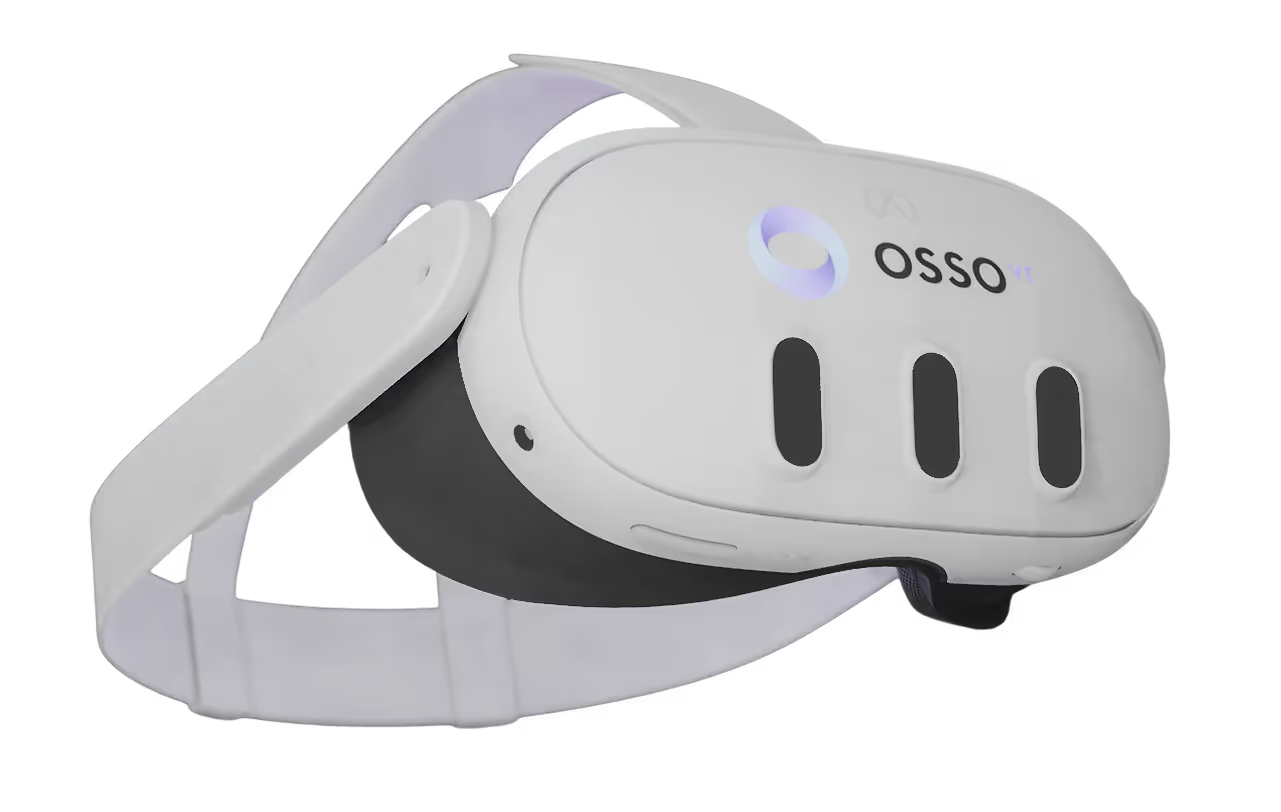
In many of these strategic conversations, VR comes up as a way to shift repetition into a format learners can access independently, effectively freeing educators and preceptors to focus their limited energy on higher-value mentorship moments, such as nuanced coaching and the development of complex clinical judgment.
Nursing leaders also emphasize an increasing sense of urgency regarding the transition to practice.
Across the country, leaders have shared how long it takes for new nurses to reach the level of comfort necessary for independent practice, and the immense difficulty of shortening that timeline without compromising quality. New graduates require significant repetition, exposure to procedures to build muscle memory and safe environments where they can make mistakes and learn from them without risk.
This tension is felt across onboarding programs and residency structures. Health systems are under pressure to bring nurses into active practice more efficiently, yet they recognize that longer onboarding times have a negative ripple effect on system-wide staffing and, ultimately, patient care.
VR is frequently identified as a solution due to its unique approach to procedural repetition. Learners can practice the same procedure several times, become familiar with the sequence, and receive immediate feedback on the key skills they need to master before encountering real patients. This makes sure that supervised patient interaction doesn't feel like the first attempt.
The third theme that is often discussed in conversation is how to scale consistency.
Traditional nursing education is shaped by real-world conditions. The instructor. The unit. The supplies available. The time a learner has to practice. That flexibility is part of what makes training responsive. It also makes consistency harder to maintain across cohorts, shifts and facilities. While this flexibility allows training to be responsive, it also makes consistency harder to maintain and scale across cohorts and facilities.
Nursing leaders often steer the conversation toward establishing a more consistent starting point rather than reducing variability to drive scale. In the webinar, Martha highlights that consistency here is less about control and more about providing a common baseline for each learner. She recommends using VR like any other simulation method. Match the tool to the goal. For repeated practice and assessment of procedures, VR can help ease the burden before learners move on to lab work or supervised care.
Nursing leaders recognize VR as a powerful complement to—not replacement for—skills labs and preceptorships. By strategically filling training gaps with accessible, repeatable, and self-directed VR medical simulations for practice, systems can alleviate pressure on physical resources and scheduling while generating the objective, measurable data that transforms training completion into genuine clinical readiness at the bedside.
For a deeper look at how nursing leaders are approaching VR, explore the HealthStream and Osso VR webinar recap: VR Nurse Training: 5 Key Takeaways from HealthStream x Osso VR.
Using HealthStream? Talk to your HealthStream representative about adding Osso Nurse Training as part of your nursing residency or onboarding program.
Not a HealthStream customer? Connect with the Osso VR team to discuss how Osso Nurse Training can support procedural skills training and how it fits into your current learning management system.