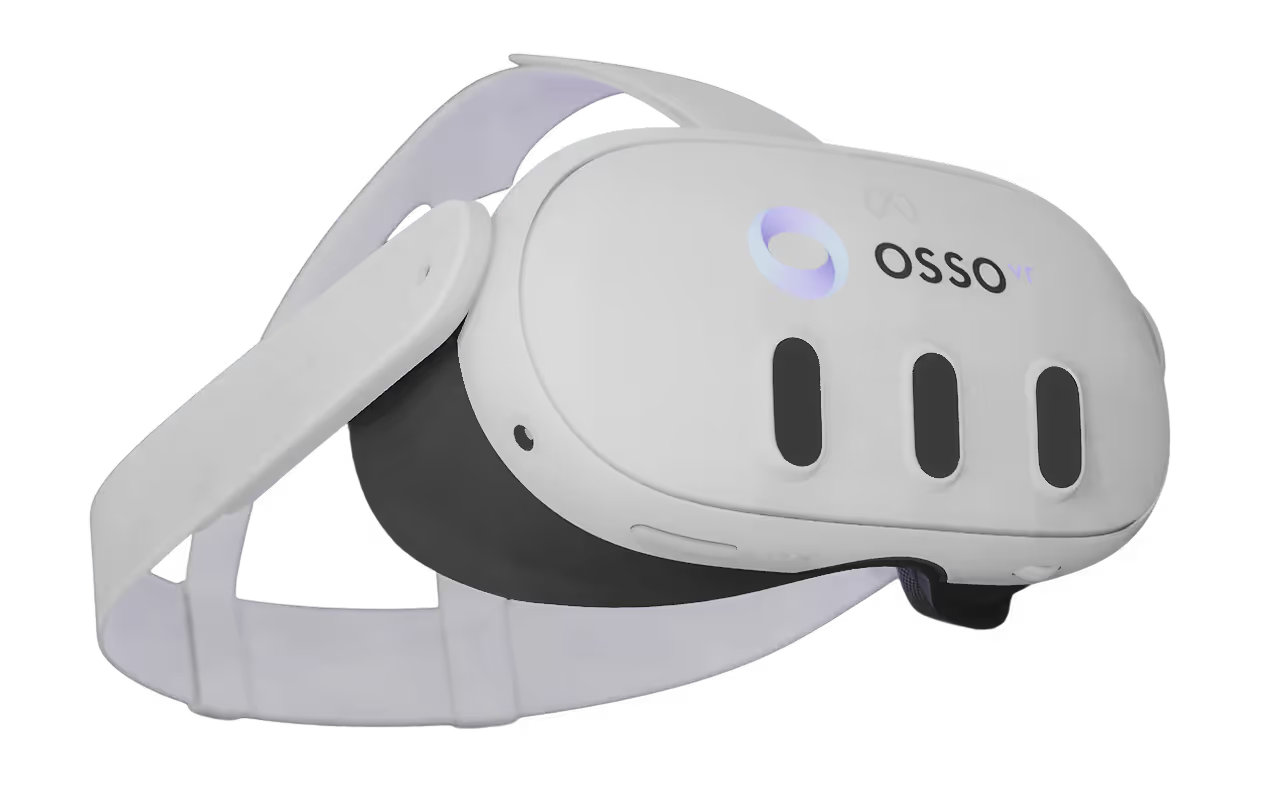
New graduate nurses take up to 12 months to reach independent practice, which is a timeline that's unsustainable when retention rates are already below target. In a recent HealthStream webinar, clinical experts at Osso VR unpacked five ways VR is changing that, from objective competency to on-demand skill building at scale.
Nursing leaders feel more pressure to tackle a problem. In many systems, the average time to onboard new graduate nurses is over a year. Building real confidence and skill can take the whole length of a residency program.
Osso VR and HealthStream addressed this challenge directly with a webinar on VR procedural skills training in nursing. Leading the discussion were two people who understand the problem from the inside. Martha Levine, PhD, RN, RNC-OB, C-EFM, C-ONQS and Curriculum Lead at Osso VR, is a nurse educator, simulationist, and enterprise Nurse Residency leader with nearly 30 years of experience designing and scaling immersive learning strategies. Justin Barad, MD, co-founder and Chief Strategy Officer of Osso VR, is a practicing pediatric orthopedic surgeon who founded Osso VR in 2016 to bring objective, engaging VR training to healthcare.
In this article, we cover five key takeaways from the webinar:
The experience gap between nursing school and the demands of independent bedside practice has been widening for years, and health systems are absorbing the costs every day.
“This is bigger than just one hospital or one hospital system. Nationally, nursing leaders are telling us the same thing. Too many new grads aren't reaching proficiency in their critical technical skills as quickly as our patient care situations demand.”
The consequences impact the entire system. For CNOs and system leaders, 12 months to independent practice means extended onboarding, sustained pressure on preceptors, and a retention risk when new nurses feel underprepared. And for educators, it means closing skill gaps that should have been closed sooner.
The problem isn't effort. It's access to the right kinds of practice at the right time. Skills labs, videos, and skills guides remain valuable, but they depend on availability, scheduling, and often an educator to be effective. Virtual reality (VR) removes those dependencies. It gives nurses a way to shorten the learning curve with structured, repeatable practice on critical procedural skills before they ever reach the bedside.

Nurse educators have to be resourceful. When the tools and supplies needed to run a skills training session are unavailable, many find a way to run it anyway.
"As an educator and a simulationist, I was constantly improvising to provide as many hands-on practical experiences as I possibly could. I would raid the expired supplies. I purchased equipment on eBay and Amazon with my own money. I really felt like it was exactly what I needed to do in order to provide the best experiences for my learners, even though I had to fill the back of my minivan with tubs and bins of supplies."
Nurse educators share Martha's commitment. However, relying on individual resourcefulness is not a training strategy. It does not work consistently across units, sites, or shifts, and the pressure falls on educators.
Health systems need a training model that operates at scale, delivering a consistent experience regardless of who is teaching, what supplies are available, or when practice is needed. Using VR, the same training experience can be delivered across all units and shifts using only a headset.
Feeling ready and being ready are not the same thing. In healthcare, the space between these two states is where risk exists. Justin highlighted this during the webinar with a finding from a published randomized trial comparing VR training to a standard guide.
"The person who felt ready checked that piece of paper 26 times. The person who is measured to be ready checked it zero times."
The gap seen in the trial isn't about a person's effort or intelligence; it highlights what traditional training doesn’t teach. A new graduate nurse might finish a competency checklist and pass an observed skills assessment. However, they may still rely on memory, checklists, or support from educators rather than demonstrating true procedural fluency.
VR removes these safety nets in a controlled way by recording what really happened: which steps were taken, in what order, how accurate they were, and how long each task took. It captures what a learner actually did, not how they felt.
In the same study, healthcare professionals trained with VR scored much higher on overall assessments. They completed more than twice as many procedural steps correctly compared to those trained with a standard guide alone. The results remained consistent in a follow-up two weeks later, showing better knowledge retention rather than just short-term recall–competency documentation from assumption to evidence, giving CNOs and system leaders a way to justify decisions that a paper checklist never could.
The VR group had performance scores 230 to 300% of those of standard guide cohort (p < 0.001).
If nursing curriculum is already working, VR is not intended to replace it.
"The goal really isn't to replace what is working in your educational and skills training programs. It's to augment your teaching, integrate new skills and accelerate practice readiness."
VR absorbs the early, repetitive part of the learning curve so that every other resource in the pathway can do its best work. A blended curriculum does not require educators to take on additional tasks. Instead, it encourages tools to handle more. Educators can concentrate less on basic skills and more on clinical judgment, nuance, and coaching. The skills lab becomes a space for refinement rather than introduction.
"You have the VR training and assessment to supercharge the first 80% of your learning curve, and then maybe you're tailing that off with a skills lab as more of a master class now, or supervised patient interaction."
For system leaders, the value is consistency. A standardized VR scenario provides the same training experience across every unit, site, and shift. Onboarding a large group of new graduates no longer relies on the availability of a sim lab, a preceptor, or a full supply bin.
Not every nurse trains during the day shift. Not every unit has regular access to a sim lab. Not every new graduate starts orientation with the same background.
A training model that only works in perfect conditions is not a true training model. VR removes these limitations. Nurses can access a training module at any time, repeat a procedure as often as needed, and practice in a low-pressure setting. Procedures seen only a few times a year are usually the ones where confidence declines fastest. VR offers nurses a way to refresh those skills without waiting for a scheduled lab or a preceptor.
Learning under observation affects a learner's willingness to try. In a traditional skills setting, uncertainty comes with social pressure. In VR, that pressure disappears. Nurses can pause, repeat, and practice at their own pace, without being evaluated in real time.
VR also goes well beyond just the individual learner.
"You can bring in a remote instructor from anywhere in the world. While VR can be completely self-serve, if you want to supercharge the experience, you can bring an expert like Martha in from another state to help you, observe you, give you clinical tips and make that training experience even more engaging."
For health systems with multiple sites and rotating staff, having consistent access to training is not guaranteed. VR makes this possible.
New graduates need more practice opportunities than current training systems can provide reliably. Educators need tools that can scale. Leaders need solid competency data. A training solution should be designed to tackle all three at once.
Osso VR and HealthStream are making that solution accessible to health systems nationwide through Osso Nurse Training, part of a connected learning experience with Dynamic Health from EBSCO Health Care Clinical Decisions.
The full webinar goes into more detail about the research, the blended learning model, and what implementation looks like in practice. If you use HealthStream, watch the full recording and talk to your HealthStream representative about bringing Osso Nurse Training to your health system.
If you're not a HealthStream customer, contact the Osso VR team to learn more about Osso Nurse Training and how it fits into your current learning management system.